
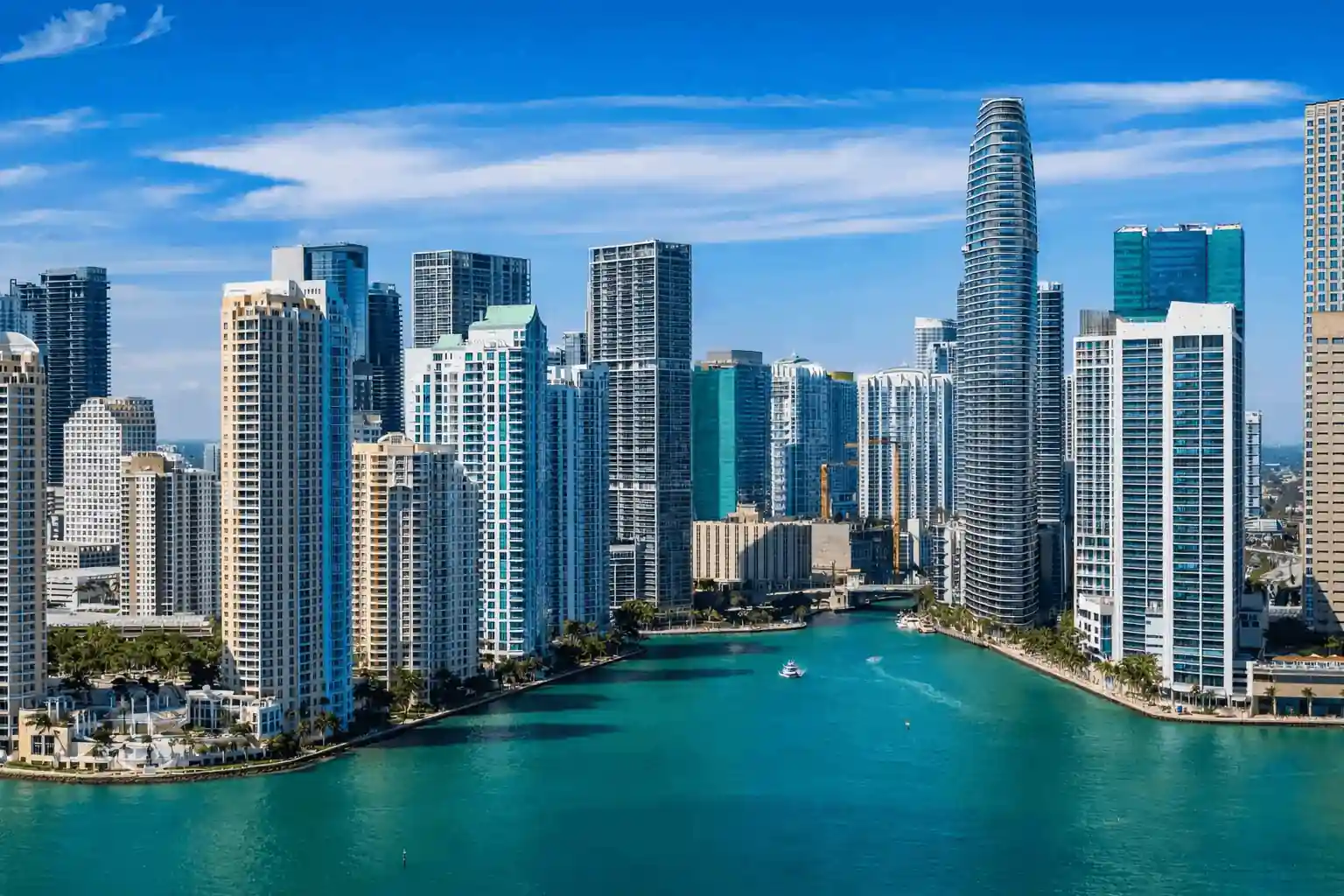
Brickell
Miami-Dade County
Brickell
The high-rise financial district of Miami, centered on Biscayne Bay towers, with a street grid that's easy to cover on foot.
South Florida
Miami-Dade and South Florida Neighborhoods
Want a different town or district?
Yes. You can browse homes in more than 500 towns and districts.
Miami-Dade neighborhoods: what to compare
Comparing areas across South Florida
Guides describe a place's character, yet you close on a single address. Neighboring blocks can sit in different flood zones. Across the street, a condo and a house face separate insurance and tax treatment. A route that looks quick on the map at noon is a different trip once you start it at eight in the morning.
These checks work for any address in Miami-Dade, in Broward or in Palm Beach, with or without a guide on this site for its area. Each one names the office whose published record gives the answer, so you can check it yourself before you put an offer on paper.
Due diligence
Six checks that apply to any address
Flood zone and elevation
On FEMA's maps, each parcel carries a flood zone. A parcel inside a Special Flood Hazard Area, meaning the zones lettered A or V, brings a federally regulated lender's insistence on flood insurance for the whole loan. Zone X still means reduced mapped risk, which is not the same as no risk. Before the contract is signed, a Florida home seller has to give written notice of any known flood damage, any flood claim and any federal aid for flooding.
42 U.S.C. §4012a · F.S. §689.302
Insurance quote before price
Ask for a homeowners quote before you settle on a price, not once it's agreed, and add a flood quote where one is relevant. Premiums lean hard on roof age and on window and door protection. Florida requires insurers to offer discounts for verified wind-mitigation features, and an inspection report on those features can shift the premium.
F.S. §627.0629
Property tax after the sale
What the seller pays says little about your own bill. On the first January 1 after the sale, the home's assessment is reset to just value. Your rate adds up city and county levies, along with any special-district levy. The homestead exemption is open only to a permanent residence, and you file the application with your county's property appraiser, due by March 1. After that, assessed value may go up each year by no more than the lesser of 3% and inflation.
F.S. §§193.155, 196.011, 689.261
Condo, townhouse or house
A condo comes with its own association, budget and rules. In a building of three or more habitable stories, the milestone structural inspection must happen by December 31 of the year in which the building turns 30. Near salt water, where the local building official requires it, that deadline moves to year 25. The building also needs a structural integrity reserve study, repeated every 10 years. Read both, plus the leasing rules, before the view sways you.
F.S. §553.899 · §718.112(2)(g)
Commute at your own hours
Run the commute yourself on a weekday, leaving when you actually would, and repeat it in the evening. Note every bridge or causeway on the route. From a barrier island, those crossings dictate the speed of any trip to the mainland.
Plans for the surrounding block
Check public city planning and zoning files for the blocks near the address: approved towers, rezoning requests, a planned station or a road widening, for instance. What gets built there decides the next owner's window views and the noise at night.
Three kinds of places
How coast, city center and inland differ
Three settings cover most addresses in South Florida. Each has its own kind of housing, its own cost drivers and a matching list of things to check.
Coast and barrier islands
- Housing
- Beachfront condo towers, older low-rise buildings, and houses on lots along the bay or a canal.
- What pushes the cost up
- Flood insurance in high-risk zones and wind insurance weigh heavily, as do condo budgets that pay for concrete repair, roofs and seawalls.
- Verify before an offer
- Look up the flood zone along with an elevation certificate, read the building's milestone inspection together with its reserve study, and test the causeway when traffic peaks.
Downtowns and high-rise towers
- Housing
- Lofts, townhouses on the fringe and towers with their own amenities, all near restaurants, offices and transit.
- What pushes the cost up
- Association fees cover staff, amenities, insurance and reserves; a parking spot may be sold or leased separately.
- Verify before an offer
- Check the leasing rules and minimum lease terms, any special assessments passed or under discussion, and what the fee covers.
Inland neighborhoods
- Housing
- Larger lots with single-family homes, newer planned communities and townhouses.
- What pushes the cost up
- Several things drive costs: roof age and construction type, which shape insurance, HOA fees and, in some newer developments, a community development district (CDD) assessment added to county taxes.
- Verify before an offer
- Confirm the HOA and CDD figures, the roof's age and permits, and a test commute at the hours you would really travel.
Coastal and inland are tendencies, not rules: zone AE may apply to an inland canal lot, and zone X to a coastal street. Only the address itself settles it.
Using this page
From area guide to shortlist
Compare several guides
Each guide gives location, housing types, transport and nearby amenities. Two or three guides compared beat a single guide studied closely.
See what's for sale
Press the Homes for sale button and the area's live search opens, showing current prices, sizes and days on market. Read the guide for the feel of the area and the search for the count of what's available.
Compare two areas directly
Compare Areas lines up two places using the same metrics, so you see the trade-off on one screen.
Check one address against official records
Once you like a particular home, pull the public record on it for permits, flood zone and assessed values. A condo adds the building's filings. The checks above show you what the inspection should cover.
Visit twice
Pick a weekday at rush hour for one visit and a weekend evening for the other. Cover the block on foot, take the drive, and linger where noise is most likely.
Questions
Questions about the area guides
Why can't I find my city or neighborhood among the guides?
The guides are a selection, not the edge of the map. The home search covers more than 500 cities and neighborhoods across South Florida, and every check on this page applies to any of them. You can also ask about a place directly.
Can the guides tell me which area is right for me?
No. The guides describe parks, housing, transit and distances, and the choice stays yours. To turn your own priorities into a shortlist, start with the Neighborhood Quiz.
Where do the market figures in a guide come from?
The figures come from live listing data, counted within the area's borders when the guide opens. They cover active listings, not completed sales. For a given home, recently closed sales nearby tell you more than a median for the whole area.
How do I find the flood zone for an address?
Look the address up in FEMA's Flood Map Service Center for its official flood zone. For the building's own height, a licensed professional prepares an elevation certificate, and the seller can tell you whether one exists.
Do all homes in one area pay property tax alike?
No. Bills differ even inside one area. The rate reflects city and county levies plus any special-district levy such as a CDD, while the taxable value is set per home from its assessment and exemptions. Two similar houses on the same street can end up with very different bills when a homestead cap built up over years applies to only one.
Keep going
Tools for your search
- Compare AreasTwo places side by side, on the same measures.
- Neighborhood QuizDescribe the place you want and get a shortlist of three areas to research.
- Miami-Dade Property Search ReportSee one address's official record: permits, flood zone and values.
- Florida Home InsuranceGet a premium estimate before you agree on a price.
Sources
Primary sources for the rules quoted on this page.
- FEMA Flood Map Service Center
- 42 U.S.C. §4012a — flood insurance requirement
- Flood disclosure by the seller: F.S. §689.302
- F.S. §627.0629: wind-mitigation discounts
- F.S. §193.155 — homestead assessments
- Filing for exemptions: F.S. §196.011
- Property tax disclosure to buyers: F.S. §689.261
- Milestone inspection rules: F.S. §553.899
- F.S. §718.112: structural integrity reserve study
- CDD disclosure: F.S. §190.048